
The first quarter of 2026 came to a close last week, and it played out in two distinct acts.
The quarter opened with momentum. The music was playing and people were dancing. The record may have been a little quieter and starting to skip, but nobody was reaching for the needle. The S&P 500 touched 7,000 for the first time on January 28th, capping three consecutive years of double-digit returns and reflecting a market that convinced itself that the soft landing wasn’t just possible, it was done. Inflation was cooling, the Fed appeared poised to cut rates, and AI-driven earnings growth was rewriting expectations across corporate America. The biggest names in the tech announced lofty capital expenditure targets and ambitious new projects, and the train that had barreled down the tracks for three years was widely expected to keep chugging. Confidence was high. Perhaps too high.
Then the cracks started to appear. Quiet rumblings that may have started before the holiday season, quickly snuffed out by stuffing and stockings, reemerged in financial headlines. Hundreds of billions in pledged AI spending suddenly became a liability, and software was now at risk of being commoditized by the very technology it had helped build. The rotation was underway before investors had time to register it. The narrative wasn’t all bad, though. With the high-flyers taking a seat on the bench, areas of the market that hadn’t received much playing time over the prior three years, value and international in particular, began to stir. This might just be their year. Then, on February 28th, the narrative changed. U.S. and Israeli forces launched strikes on Iran, triggering an effective closure of the Strait of Hormuz and the largest oil supply disruption in modern history. Inflation fears reignited. Expectations of a rate cut evaporated. Stocks, bonds, and gold fell in tandem.
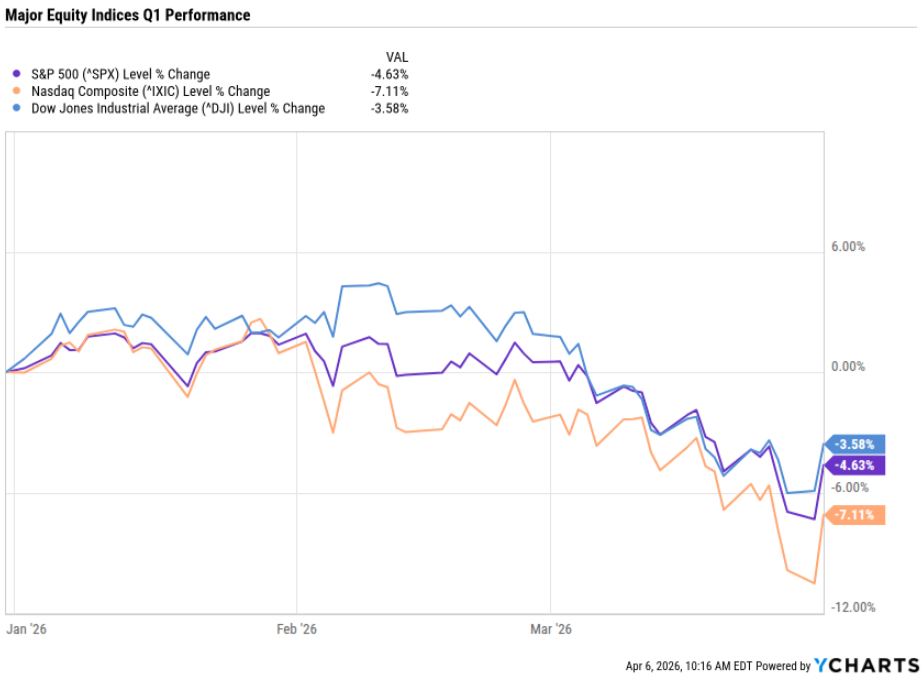
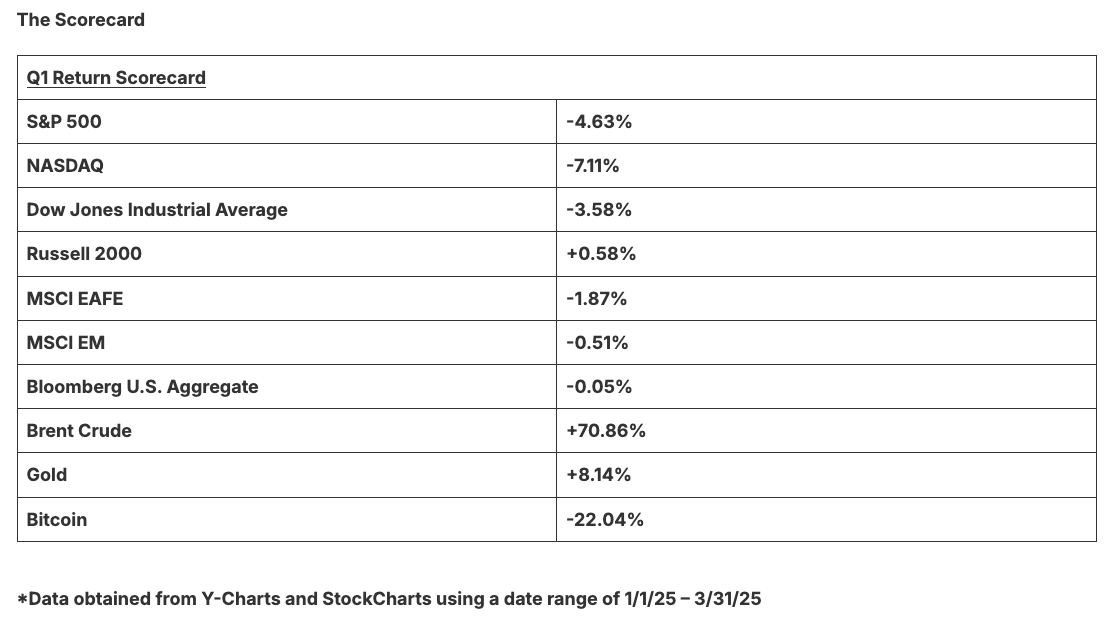
By March 31st, the S&P 500 had shed 4.63% for the quarter. The story of Q1 2026 isn’t simply one of a market that went down. It’s the story of two separate shocks that each, on their own, would have defined the quarter. Together, they redefined the outlook for the year.
The Stage is Set
Heading into 2026, the U.S. economy looked resilient. Yes, I can hear the interjections already. “But what about GDP in the fourth quarter?” And it’s a fair point. Following the latest revision in early March, the headline GDP print for Q4 2025 came in at a mere 0.7%, but that figure requires important context. The 43-day government shutdown, the longest in U.S. history, distorted the number significantly. An estimated 1.2 percentage points came off the print from government restrictions on spending alone. Strip that out, and the underlying picture was considerably healthier. Consumer spending grew at a 2.0% annualized rate in Q4, and business fixed investment expanded at 2.2%, driven heavily by AI-related data center buildout. The Fed had cut rates three times in the second half of 2025, bringing the federal funds rate to a range of 3.50% – 3.75%. Inflation, while still above target, was trending in the right direction. CPI was running at 2.4% year-over-year through January, with PCE at 2.8%. Unemployment was holding steady near 4.4%. The labor market wasn’t booming, but it wasn’t breaking. In short, markets entered Q1 with a reasonable economic foundation. The coveted soft landing had arrived. The question was simply how long it could hold.
Act One: The AI Reckoning
For nearly three years, artificial intelligence had been the market’s North Star. From the spring of 2023 to the end of 2025, the AI trade drove one of the most powerful bull runs in modern market history, lifting semiconductor stocks, hyperscalers, and everything adjacent to the buildout. Investors looked past the mounting capex bills, trusting that the returns would eventually justify the spending. By early 2026, that trust was beginning to crack.
I want to make it abundantly clear. The AI trade is not over. Technology, communication services, and cyclicals should not be put out to pasture. But the trade has lost significant wind from its sails and floated adrift through Q1. The performance data backs that up.
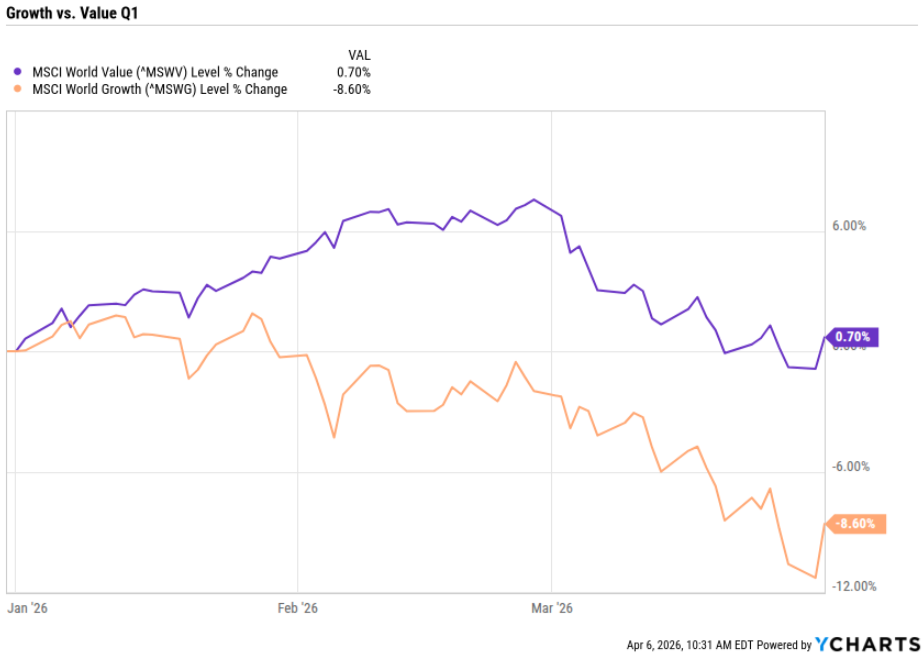
During the first quarter, value stocks gained 0.7% as measured by the MSCI World Value Index, while growth stocks fell 8.6% as measured by the MSCI World Growth Index. Small caps, energy, utilities, and consumer staples took the baton from mega-cap tech. Perhaps the most significant shift, however, was geographical. International equities, long overshadowed by U.S. large-cap dominance, began attracting meaningful inflows as investors questioned whether concentration in the U.S. had simply become too great. European and Japanese equities outperformed early in the quarter, with the Nikkei 225 up 16.91% and the MSCI Europe up 7.68% through February 27th. For the first time in a long time, international diversification was working. Investors who had looked beyond U.S. borders were being rewarded for it.
On the other side of the ledger, the “AI loser trade” started quietly in the software sector. The concern was not that AI was failing. It was that it was performing too well and coming directly for the SaaS business model. A new generation of capabilities was raising serious questions about the durability of enterprise software. Why pay significant per-seat subscription fees when a general-purpose AI can replicate those workflows at near-zero marginal cost? The selloff spread from software to trucking, commercial real estate, financial data, and beyond. Any industry where AI disruption looked plausible was suddenly in the crosshairs. To underscore market impact, Microsoft closed the quarter down 23.4%, its worst quarter since Q4 2008 and its worst start to any year since going public in 1986.
The Fed, meanwhile, still appeared on track to cut rates. Incoming chair Kevin Warsh was seen as accommodative, and by mid-February the case for at least two cuts in 2026 looked solid. Gold surged above $5,300 an ounce on a wave of geopolitical uncertainty stemming from the U.S. incursion into Venezuela, then abruptly collapsed more than 13% in a matter of days as speculative positions unwound. It was a disorderly but manageable quarter until February 28th.
Act Two: The Gulf Changes Everything
On February 28th, the United States and Israel launched coordinated strikes on Iran under Operation Epic Fury, targeting military installations, nuclear sites, and senior leadership, including Supreme Leader Ali Khamenei. Within days, Iran’s Islamic Revolutionary Guard Corps effectively closed the Strait of Hormuz, the narrow waterway through which roughly 20% of the world’s oil and LNG supply passes daily. What had been a market story about AI disruption became an energy crisis overnight.
Oil told the story most starkly. Brent crude had been trading around $70 per barrel heading into March. It surpassed $100 on March 8th for the first time in four years, peaked at around $120 per barrel, and stabilized in the $100-$110 range through the end of the quarter. Gasoline prices at the pump hit $4.05 per gallon by March 31st. The IEA coordinated its largest ever strategic reserve release of more than 400 million barrels, and it barely moved the needle. The damage extended well beyond oil. A key LNG facility in Qatar was struck, aluminum production plants were hit, and the downstream effects on helium, a critical component in semiconductor manufacturing, raised fresh concerns about technology supply chains.
The Fed, which had been widely expected to cut rates twice in 2026, went on hold. At its March meeting it was voted 11-1 to hold rates at 3.50%-3.75%, explicitly citing the energy shock. Bond traders, who had briefly seen the 10-year yield down below 4% in February, watched yields climb toward 4.35% by quarter end. Stocks, bonds, and gold fell together. The classic diversification playbook broke down.
As Q1 closed, both sides murmured about a willingness to negotiate sending markets higher on the final day of trading of the quarter. But at the time of writing, the Strait remains closed, the situation fluid, and the full economic consequences still unfolding.
What to Watch in Q2
The defining variable heading into Q2 is one that no economic model can reliably forecast: the duration of the Iran conflict. A swift resolution and reopening of the Strait of Hormuz would likely trigger a sharp relief rally across risk assets, a pullback in oil, and a rapid repricing of Fed expectations back toward cuts. A prolonged closure, particularly one stretching into the summer, risks a deeper stagflationary impulse that would put the Fed in an increasingly difficult position and pressure corporate earnings in ways no yet reflected in analysis estimates.
On the monetary policy front, all eyes will be on Fed Chair Jerome Powell’s final weeks in office, with his term expiring in May. The transition to an incoming chair under these conditions adds an additional layer of uncertainty. Markets will be closely watching for any signals of a shift in posture, dovish or otherwise, at a moment when the Fed’s credibility depends on staying the course.
Q1 earnings season, beginning in mid-April, will serve as the first real stress test of how corporate America is absorbing the energy shock. Guidance will matter more than results with investors looking for clarity on margin impact, supply chain exposure, and capital expenditure plans in an environment where the cost of doing business has shifted materially in a matter of weeks.
The first quarter of 2026 reminded investors just how quickly the narrative can change. In the span of three months, markets went from pricing perfection to pricing conflict. The debate went from the ROI of AI capex to watching oil tankers navigate a war zone. The two forces that defined the quarter, technological disruption and geopolitical shock, are not going away. Both storylines are likely to grow more complex as the year progresses. What Q1 made clear is that diversification, discipline, and a willingness to look beyond the dominant trade of the prior cycle are not just sound principles, they’re essential.
Disclosure: I/we have no stock, option or similar derivative position in any of the companies mentioned, and no plans to initiate any such positions within the next 72 hours. I wrote this article myself, and it expresses my own opinions. I am not receiving compensation for it. I have no business relationship with any company whose stock is mentioned in this article.
Investment advice offered through Great Valley Advisor Group (GVA), a Registered Investment Advisor. I am solely an investment advisor representative of Great Valley Advisor Group, and not affiliated with LPL Financial. Any opinions or views expressed by me are not those of LPL Financial. This is not intended to be used as tax or legal advice. All performance referenced is historical and is no guarantee of future results. All indices are unmanaged and may not be invested into directly. Please consult a tax or legal professional for specific information and advice.
LPL Compliance Tracking #1089027.